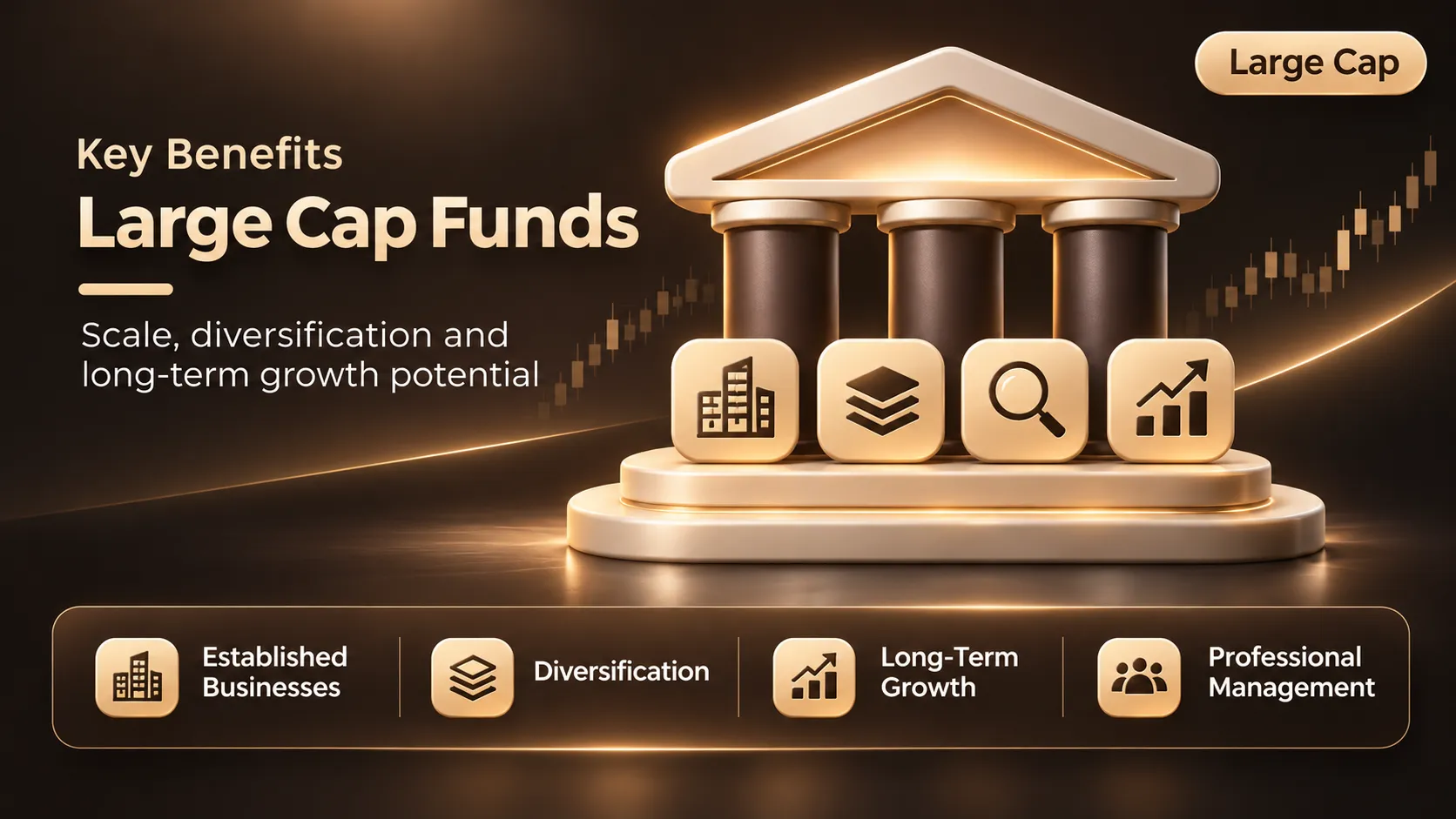
When building an equity portfolio, investors often look for exposure to established businesses with a strong market presence. Large cap mutual funds offer way to access these companies.
Their appeal lies in the scale and maturity of the underlying businesses, diversification, and potential for long-term growth. However, large cap funds remain equity investments: their value can fall, and company size does not guarantee returns.
Here is how large cap funds work, what benefits they offer, and what to consider before investing.
What Are Large Cap Funds?
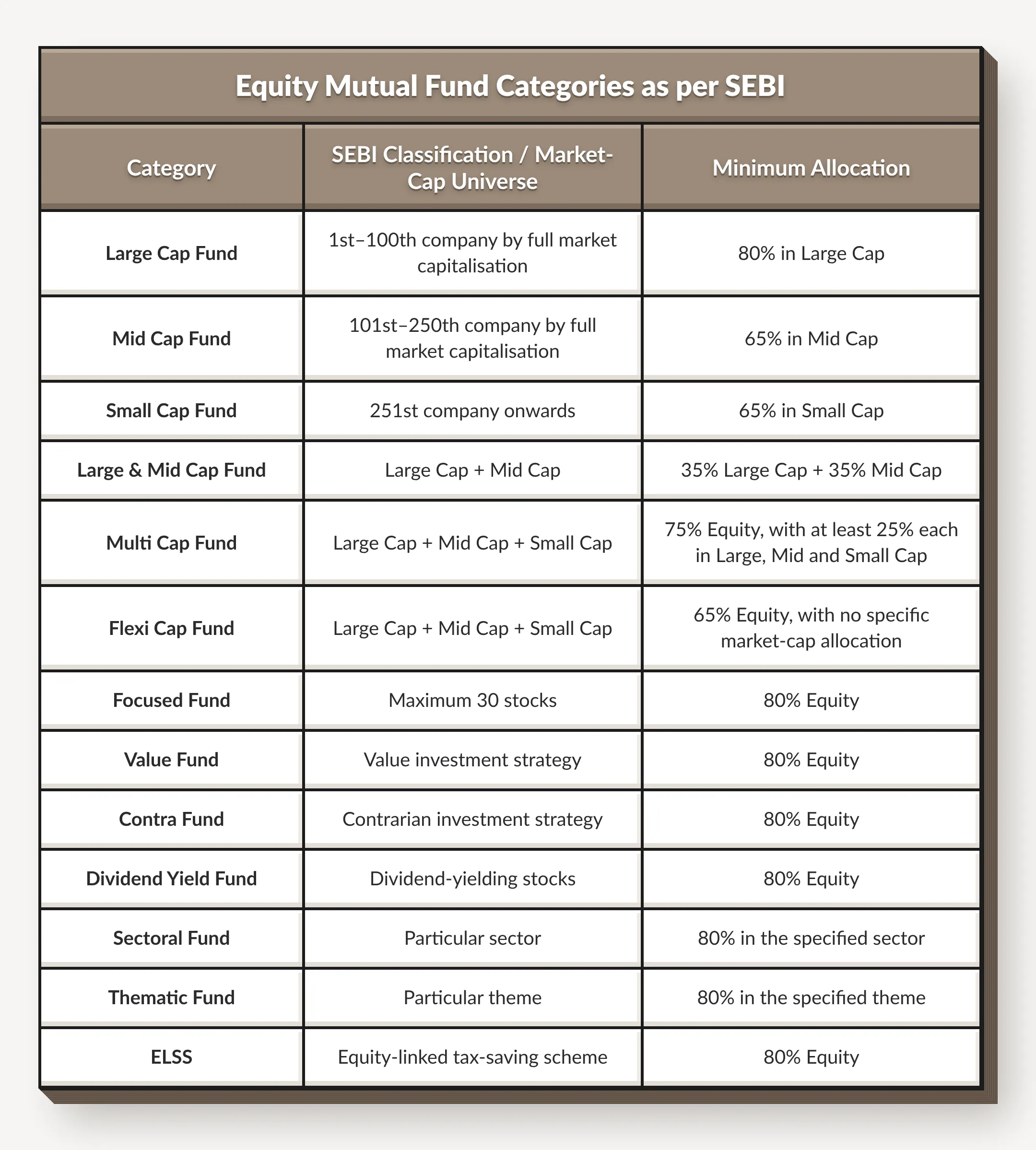
Large cap funds are equity mutual funds required to invest at least 80% of their total assets in equity and equity-related instruments of large cap companies. Under SEBI’s classification, large cap companies are the first 100 companies ranked by full market capitalisation.
Market capitalisation is the market value of a company’s outstanding shares. It measures company size, rather than profitability, investment quality or how attractively the shares are priced.
The 80% requirement is supported by SEBI’s February 2026 categorisation circular.
Large cap funds are also sometimes associated with blue chip mutual funds. “Blue chip” is a commonly used description for established companies, rather than a separate SEBI mutual fund category. Check a scheme’s stated category and investment mandate instead of relying on its name.
SEBI Classification of Equity Mutual Fund Categories
How Do Large Cap Mutual Funds Work?
A large cap mutual fund pools investors’ money and invests according to its stated mandate. In an actively managed scheme, the fund manager selects companies and decides portfolio weights using research on earnings, valuations and business prospects.
Investors hold units of the fund rather than directly owning its underlying shares. The value of these units changes with the portfolio’s performance, after accounting for scheme expenses.
Investments can be made through a lump sum or a Systematic Investment Plan (SIP), subject to the scheme’s terms.
Key Benefits of Large Cap Funds
1. Exposure to Established Businesses
Large cap funds provide access to businesses that have achieved significant scale. These companies may benefit from established customer relationships, wider distribution networks and better access to capital.
These strengths can support their ability to navigate business challenges, but it does not necessarily make every large cap company a good investment. Valuation and business quality still matter.
2. Portfolio Diversification
A large cap fund spreads investments across multiple companies and, depending on its strategy, different sectors. This can reduce the impact of poor performance by an individual company.
However, diversification varies by scheme. A fund with substantial exposure to a few stocks or one sector can still carry concentration risk, and diversification does not prevent losses during a broad market decline.
3. Potential for Long-Term Capital Appreciation
Established companies can grow through expansion, innovation, improved efficiency and gains in market share. Investors may benefit when that growth translates into improved company earnings over time.
4. Professional Research and Portfolio Management
In an actively managed large cap fund, professional teams research companies, select stocks and monitor the portfolio. This reduces the need for investors to analyse and manage individual holdings themselves.
However, Professional management does not guarantee outperformance. Investors should assess the fund’s approach, costs and results against an appropriate benchmark.
5. Potentially Lower Volatility Than Smaller-Company Funds
The scale and maturity of large cap businesses can make large cap funds less volatile than mid cap or small cap funds over some periods. However, this is a relative comparison within equity investing.
Large cap funds can still experience substantial declines. Their actual risk depends on valuations, portfolio concentration and market conditions.
Large Cap vs Mid Cap vs Small Cap
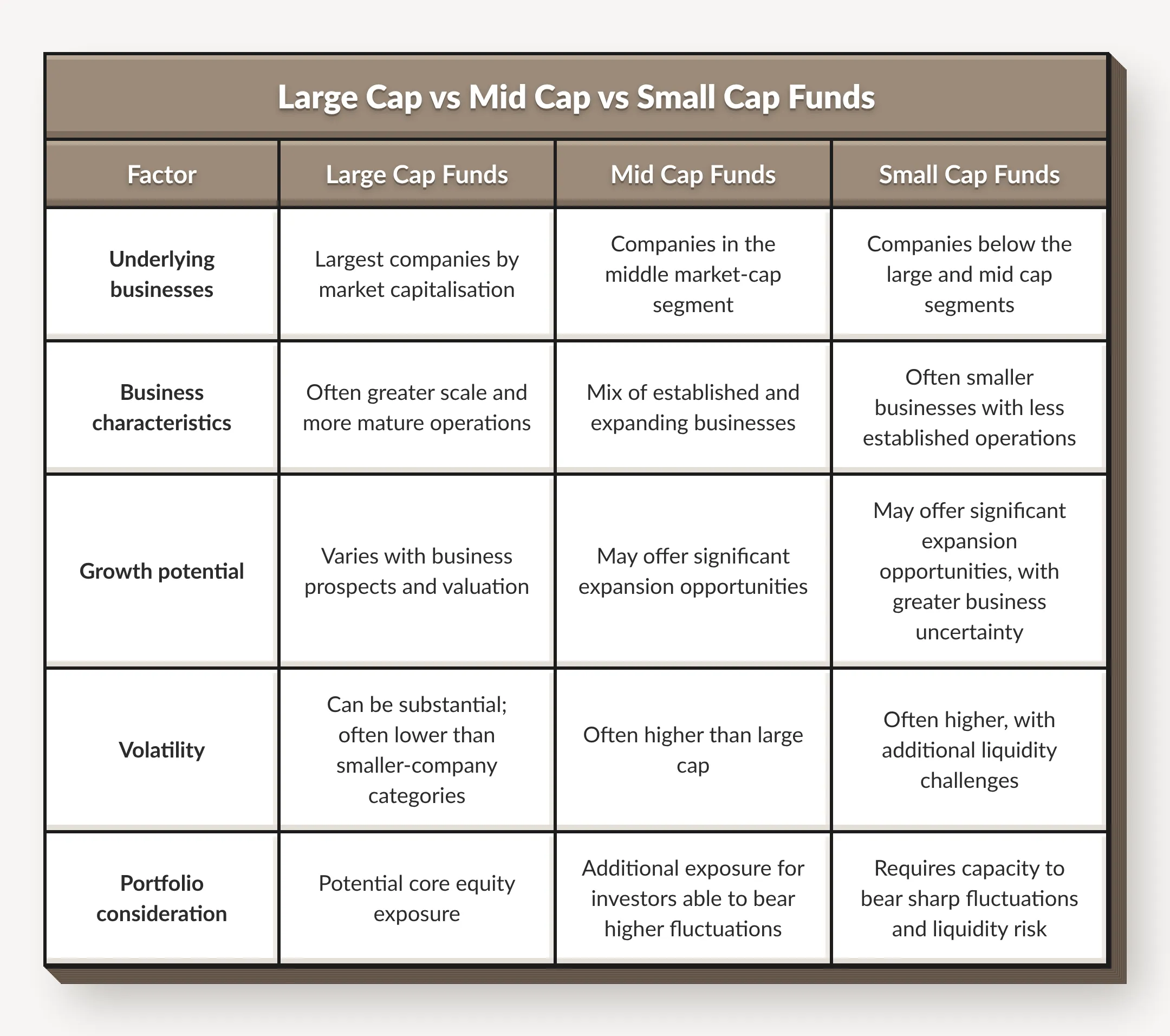
These are broad tendencies, rather than fixed outcomes. Smaller companies do not automatically deliver higher returns, and large cap funds do not always experience smaller losses.
Large Cap Funds vs Flexi Cap Funds
Flexi cap funds have the flexibility to invest across large cap, mid cap, and small cap companies. Large cap funds, on the other hand, have a defined focus on large cap equities.
This means a flexi cap fund can change its exposure across different market cap segments based on the fund manager’s strategy and market conditions.
A flexi cap fund may also hold a substantial large cap allocation. Compare its actual portfolio with the proposed large cap fund to understand whether adding both would create useful differences or simply duplicate exposure.
Active Large Cap Funds vs Large Cap Index Funds
Large cap exposure can be obtained through active funds or index funds that track a large cap index.
An active fund manager selects stocks and portfolio weights, seeking to outperform the scheme’s benchmark. A large cap index fund seeks to replicate its chosen index rather than select stocks independently.
Compare active funds using their strategy, expenses and performance against the benchmark. For index funds, examine the index being tracked, expenses, tracking difference and tracking error.
Not all index funds invest in large cap companies, so the comparison should use funds with comparable market exposure.
Are Large Cap Funds Safe?
Large cap funds do not promise capital protection or assured returns. Established companies can still face earnings pressure, business disruption and falling share prices.
The relevant question is whether the fund’s risk fits your goals, investment horizon and ability to withstand losses - not whether its underlying companies are familiar names.
Who Should Invest in Large Cap Funds?
Large cap funds may suit investors seeking long-term equity exposure to established businesses who can tolerate market fluctuations in investment value.
Suitability also depends on existing holdings, asset allocation and when the money will be needed. Investors who may need their money in the short term or have a very low tolerance for market fluctuations should first consider whether equity investments are suitable for their financial situation.
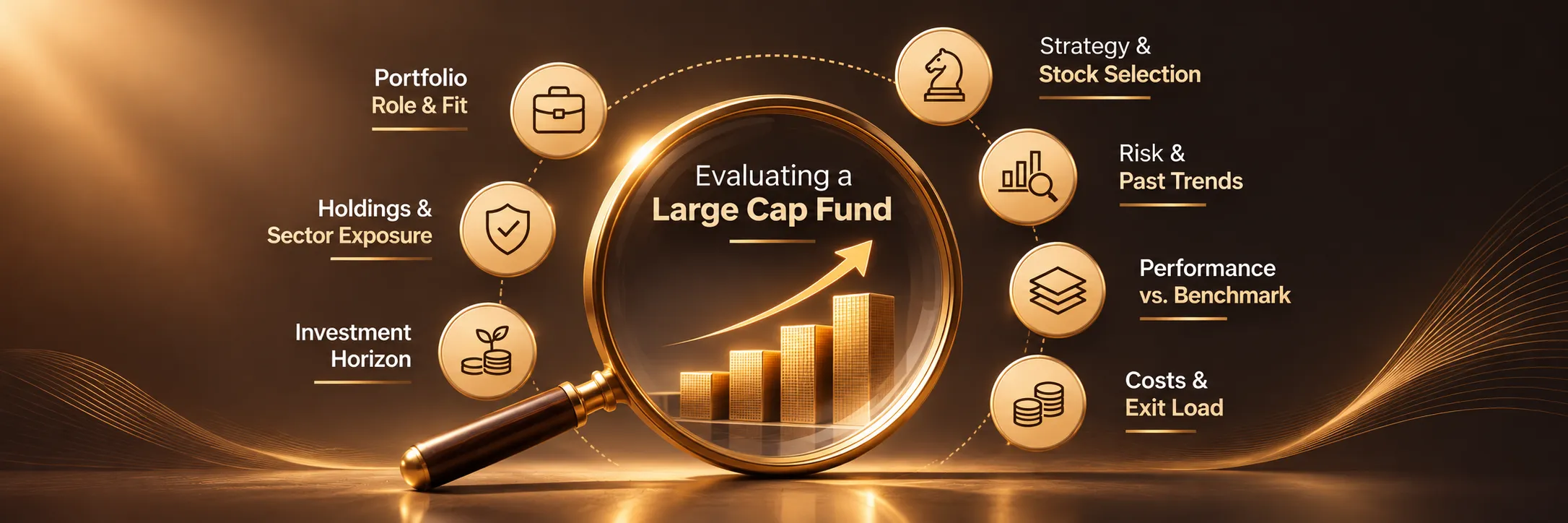
How to Evaluate a Large Cap Fund
Beginners and experienced investors should look beyond recent returns or “best fund” rankings. Assess:
- Portfolio role: What does this fund add to your existing investments?
- Strategy: How does the fund select companies and manage concentration?
- Risk: Review the scheme’s current Riskometer and its history of declines.
- Performance: For an active fund, compare results with an appropriate benchmark across different periods and market conditions.
- Holdings: Check major stocks, sector weights and overlap with existing funds.
- Costs: Review the expense ratio and applicable exit load.
- Investment horizon: Match the investment to when you expect to need the money.
Recent outperformance alone does not establish that a fund is suitable for your portfolio.
These are broad tendencies, rather than fixed outcomes. Smaller companies do not automatically deliver higher returns, and large cap funds do not always experience smaller losses.
Large Cap Funds vs Flexi Cap Funds
Flexi cap funds have the flexibility to invest across large cap, mid cap, and small cap companies. Large cap funds, on the other hand, have a defined focus on large cap equities.
This means a flexi cap fund can change its exposure across different market cap segments based on the fund manager’s strategy and market conditions.
A flexi cap fund may also hold a substantial large cap allocation. Compare its actual portfolio with the proposed large cap fund to understand whether adding both would create useful differences or simply duplicate exposure.
Active Large Cap Funds vs Large Cap Index Funds
Large cap exposure can be obtained through active funds or index funds that track a large cap index.
An active fund manager selects stocks and portfolio weights, seeking to outperform the scheme’s benchmark. A large cap index fund seeks to replicate its chosen index rather than select stocks independently.
Compare active funds using their strategy, expenses and performance against the benchmark. For index funds, examine the index being tracked, expenses, tracking difference and tracking error.
Not all index funds invest in large cap companies, so the comparison should use funds with comparable market exposure.
Are Large Cap Funds Safe?
Large cap funds do not promise capital protection or assured returns. Established companies can still face earnings pressure, business disruption and falling share prices.
The relevant question is whether the fund’s risk fits your goals, investment horizon and ability to withstand losses - not whether its underlying companies are familiar names.
Who Should Invest in Large Cap Funds?
Large cap funds may suit investors seeking long-term equity exposure to established businesses who can tolerate market fluctuations in investment value.
Suitability also depends on existing holdings, asset allocation and when the money will be needed. Investors who may need their money in the short term or have a very low tolerance for market fluctuations should first consider whether equity investments are suitable for their financial situation.
How to Evaluate a Large Cap Fund
Beginners and experienced investors should look beyond recent returns or “best fund” rankings. Assess:
- Portfolio role: What does this fund add to your existing investments?
- Strategy: How does the fund select companies and manage concentration?
- Risk: Review the scheme’s current Riskometer and its history of declines.
- Performance: For an active fund, compare results with an appropriate benchmark across different periods and market conditions.
- Holdings: Check major stocks, sector weights and overlap with existing funds.
- Costs: Review the expense ratio and applicable exit load.
- Investment horizon: Match the investment to when you expect to need the money.
Recent outperformance alone does not establish that a fund is suitable for your portfolio.
- If you’re a partner, looking to grow your business, click here - Invest with Expert Guidance. Grow with Confidence. | Centricity
- If you’re an investor, starting your investment journey, click here- Invest Yourself | Centricity
Disclaimer:
Centricity Group operates through its respective registered entities: AMFI (ARN: 189274) – Centricity Financial Distribution Pvt. Ltd. | APMI (APRN: 00803) – Centricity Financial Distribution Pvt. Ltd. | PMS (Registration No.: INP000010007) – Centricity Portfolio Managers Private Ltd. | RIA (Registration No.: INA00018559) – Centricity Advisory Services Pvt. Ltd. | RA (Registration No.: INH000029102) – Centricity Securities Private Limited
Soumya Thakur
