A mutual fund launches at ₹10 per unit.
It sounds affordable. It may even feel like an opportunity to get in early, before other investors discover the fund.
But does a lower starting NAV make a New Fund Offer (NFO) cheaper? And does being among the first investors automatically mean you're getting a better investment opportunity?
Not necessarily.
An NFO can provide access to a new investment strategy, index, sector, asset class or portfolio approach. But the fact that a fund is new does not automatically make it better than an existing mutual fund.
Before making an NFO investment, investors need to look beyond the ₹10 price tag and understand what the fund actually offers, how it compares with existing alternatives and whether it fits their financial goals and risk profile.
The Problem: New Doesn't Always Mean Better
One of the most common misconceptions about an NFO is that a fund launching at ₹10 is somehow cheaper than an existing mutual fund with a NAV of ₹100 or ₹200.
It isn't.
The NAV of a mutual fund does not determine whether the fund is cheap or expensive.
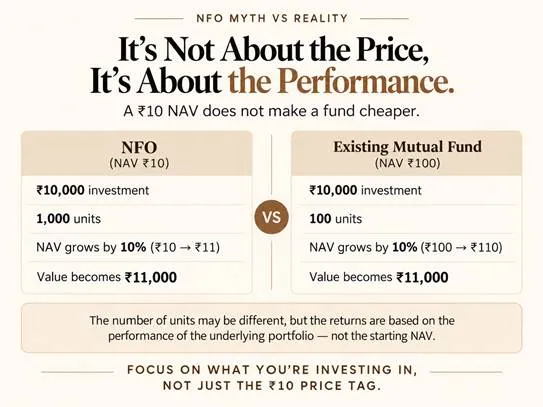
For example, suppose you invest ₹10,000 in an NFO at a NAV of ₹10.
You receive:
₹10,000 ÷ ₹10 = 1,000 units
Now suppose you invest ₹10,000 in an existing mutual fund with a NAV of ₹100.
You receive:
₹10,000 ÷ ₹100 = 100 units
You may have more units in the NFO, but that does not mean you have made a better investment.
If both funds subsequently grow by 10%:
- NFO: ₹10 → ₹11
- Existing fund: ₹100 → ₹110
Your ₹10,000 investment becomes ₹11,000 in either case, assuming the same percentage growth and ignoring applicable costs.
The number of units is different. The percentage return is what matters.
There is another important consideration.
A new mutual fund does not have its own long-term historical track record. With an existing mutual fund, investors can study past performance, portfolio composition, risk metrics and behaviour across different market cycles.
With an NFO, investors have to place greater emphasis on the investment strategy, portfolio construction, AMC and fund manager rather than relying on an established scheme-level track record.
NFOs in the Indian Investment Landscape
The Indian mutual fund industry has evolved considerably, giving investors access to a wider range of strategies, asset classes and investment opportunities.
As investor preferences change and new market opportunities emerge, Asset Management Companies (AMCs) continue to introduce new mutual fund schemes.
These may include:
- Broad-market and specialised indices
- Sectoral and thematic funds
- Multi-asset strategies
- Hybrid funds
- Equity-oriented strategies
- Debt-oriented strategies
- Fund of Funds
- Other specialised investment approaches
This makes NFOs relevant to investors looking for exposure that may not already exist in their portfolios.
However, greater choice also brings greater responsibility.
With multiple upcoming NFOs in India and frequent new mutual fund launches, investors can easily focus on the excitement surrounding the launch rather than evaluating the underlying investment opportunity.
The important question is therefore not:
“What is the latest NFO?”
It is:
“What purpose does this NFO serve in my portfolio?”
NFOs and the Mutual Fund Industry
For an Asset Management Company, an NFO is a way to introduce a new mutual fund scheme to the market.
An AMC may launch a fund to:
- Address an emerging investment theme
- Track a new or specialised index
- Provide exposure to a specific market segment
- Introduce a particular asset allocation
- Offer a differentiated investment strategy
- Respond to changing investor requirements
For investors, this creates more options.
But a growing number of products does not mean every new fund is relevant to every investor.
In fact, one of the biggest challenges for investors today is distinguishing between:
A genuinely differentiated investment opportunity
and
A new fund that offers exposure similar to what is already available.
This is why evaluating an NFO requires more than looking at its launch price or how much attention it is receiving in the market.
Data & Insights: What Should Investors Look At?
The ₹10 starting NAV is one of the least important factors to consider when evaluating an NFO.
Instead, investors should focus on the fundamentals of the scheme.
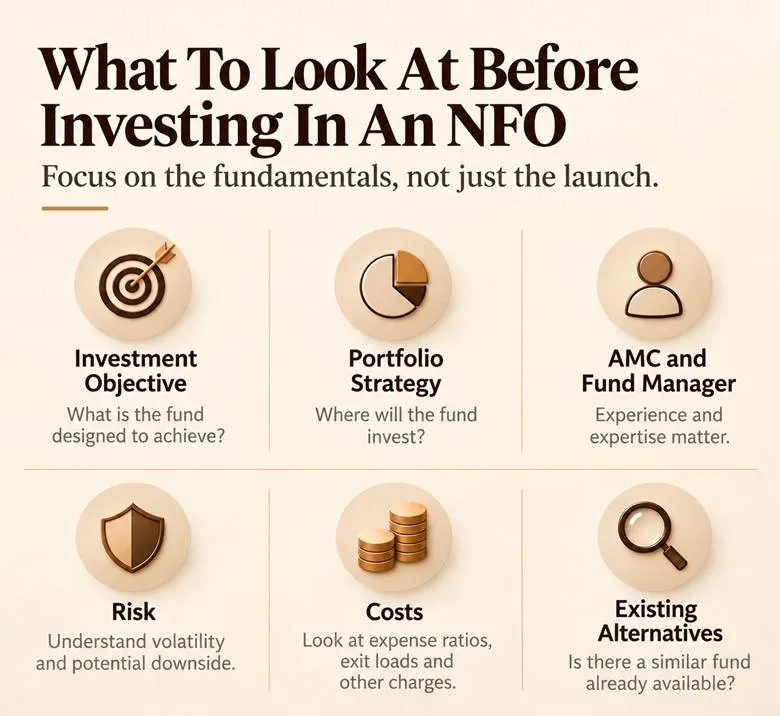
1. Investment Objective
Start with the basics.
What is the fund designed to achieve?
Does it invest in equities, debt, a particular sector, an index or multiple asset classes?
Understanding the investment objective helps determine whether the scheme is relevant to your investment needs.
2. Portfolio Strategy
Look beyond the fund's name.
Understand:
- Where the fund can invest
- Its asset allocation
- Its diversification approach
- Its investment style
- The level of concentration
- The type of securities it may hold
The underlying portfolio and investment strategy will have a much greater impact on the fund's risk and return potential than its initial NAV.
3. AMC and Fund Manager
Since an NFO does not have its own historical track record, investors can also evaluate the experience of the AMC and fund manager.
Consider their experience, investment philosophy and expertise in managing similar strategies.
However, past performance of another scheme or fund manager does not guarantee future returns.
4. Risk
Different NFOs can have very different risk profiles.
A sectoral fund, diversified equity fund, debt strategy and multi-asset fund may respond very differently to changing market conditions.
Investors should understand factors such as volatility, concentration, liquidity and potential downside before investing.
5. Costs
Expense ratios, exit loads and other applicable costs should also be considered.
The starting NAV may be ₹10, but the costs associated with managing the scheme can have a meaningful impact on long-term returns.
6. Existing Alternatives
This is perhaps the most important question:
Does an existing mutual fund already provide similar exposure?
If yes, investors should understand what the NFO does differently.
A new fund does not automatically justify an investment if an existing scheme already provides similar exposure with an established track record.
NFO vs Existing Mutual Fund
One of the most important comparisons investors should make is NFO vs existing mutual funds.
Factor | NFO | Existing Mutual Fund |
Track record | No scheme-level historical track record | Historical performance available |
NAV | Starts at the NFO offer price | Based on current portfolio value |
Portfolio | May still be getting built | Existing portfolio can be evaluated |
Strategy | New scheme-specific strategy | Established investment approach |
Fund manager | Experience can be evaluated | Scheme-level experience can be assessed |
Risk assessment | Greater reliance on strategy and framework | Historical risk and behaviour can be analysed |
This does not mean an existing mutual fund is automatically better.
The objective is to understand whether the NFO offers something meaningfully different and relevant to the investor.
The right question is not:
“Is a new fund better than an old fund?”
It is:
“Which investment is more suitable for my portfolio?”
NFO vs SIP: What's the Difference?
Another common search is NFO vs SIP.
But these are not actually competing investment products.
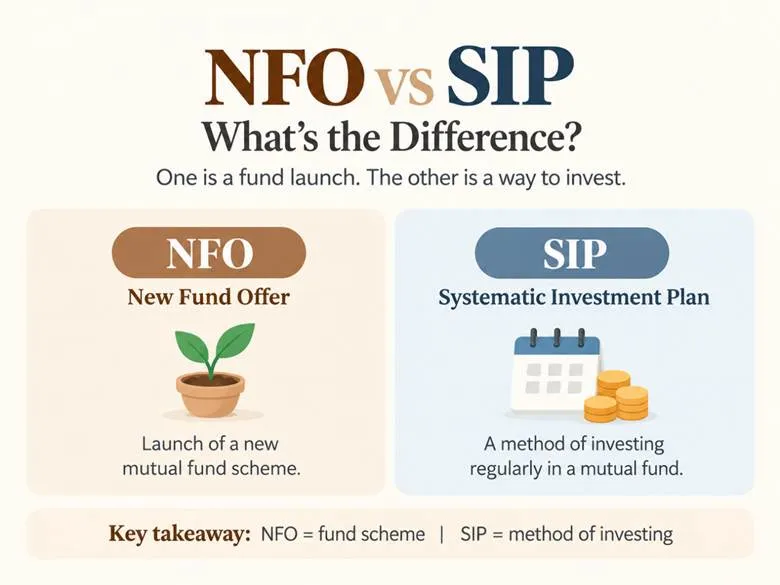
An NFO refers to the launch of a new mutual fund scheme.
A Systematic Investment Plan (SIP) refers to a method of investing a fixed amount at regular intervals into a mutual fund.
Therefore, comparing an NFO directly with an SIP is like comparing the fund itself with the way you invest in it.
Depending on the scheme's structure, investors may be able to invest through SIP after the NFO period and once the scheme becomes operational.
The important distinction is:
NFO = New mutual fund scheme
SIP = Method of investing
NFO vs IPO: Are They Similar?
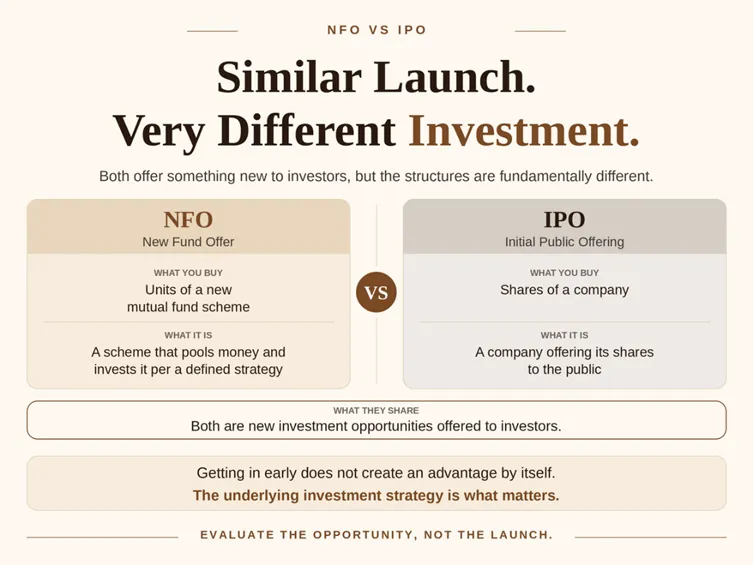
NFOs are sometimes compared with IPOs because both involve a new investment opportunity being offered to investors.
However, their structures are fundamentally different.
An IPO (Initial Public Offering) allows investors to buy shares of a company when it offers them to the public.
An NFO, on the other hand, allows investors to subscribe to a new mutual fund scheme that pools money and invests it according to a defined investment strategy.
An NFO should therefore not be approached with the mindset that simply getting in early creates an advantage.
The underlying investment strategy is what matters.
Things to Know Before Investing in an NFO
Before investing in a New Fund Offer, investors can use a simple framework:
Understand → Compare → Evaluate → Align
Understand
Read the scheme's investment objective, asset allocation and investment strategy.
Understand exactly what the fund intends to invest in.
Compare
Look at existing mutual funds offering similar exposure.
Ask what the NFO does differently and whether that difference is meaningful.
Evaluate
Evaluate:
- AMC
- Fund manager
- Investment strategy
- Risk
- Costs
- Portfolio construction
- Liquidity considerations
Align
Finally, determine whether the NFO fits your:
- Financial goals
- Risk profile
- Investment horizon
- Existing portfolio
- Overall asset allocation
This approach helps investors make decisions based on fundamentals rather than the excitement surrounding a new fund launch.
How to Invest in an NFO?
Once an investor has evaluated an NFO and determined that it may be suitable, the next question is how to invest in an NFO.
Investors can generally subscribe to an NFO through the available investment channels during the NFO period, subject to the scheme's terms, eligibility requirements and applicable regulations.
Before investing, review the relevant scheme documents and understand:
- NFO opening and closing dates
- Investment objective
- Asset allocation
- Risk factors
- Minimum investment amount
- Applicable costs
- Exit load, if any
- Redemption terms
- Whether it is an open-ended or closed-ended fund
Most importantly, ensure the investment aligns with your overall financial plan rather than investing simply because the fund is newly launched.
Is an NFO a Good Investment?
So, is an NFO a good investment?
There is no universal answer.
An NFO may be worth considering when it provides a strategy or exposure that is relevant to an investor's portfolio and financial objectives.
However, an investor should be cautious about choosing an NFO simply because:
- It is launching at ₹10
- It is a new mutual fund
- It is being heavily promoted
- It is among the latest mutual fund launches
- They believe getting in early guarantees an advantage
The investment case should come from the strategy and suitability, not the novelty of the fund.
How to Evaluate the Best NFO to Invest In?
Investors often search for terms such as:
“Best NFO to invest in”
“Best NFO in India”
“Top NFO mutual funds”
or
“Latest mutual fund launches”
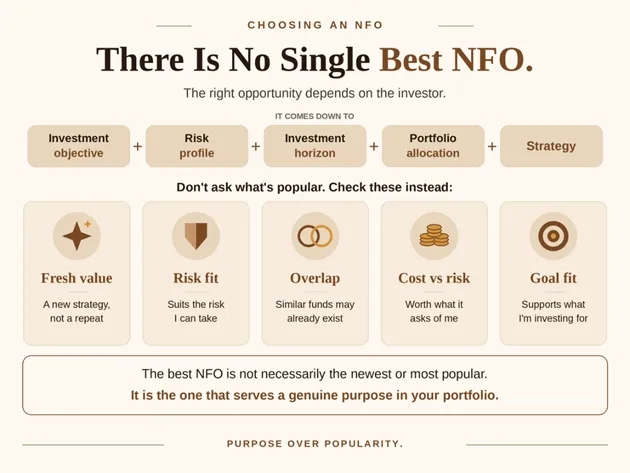
But there is no single best NFO for every investor.
The right opportunity depends on:
Investment objective + Risk profile + Investment horizon + Portfolio allocation + Strategy
Instead of asking which NFO is currently the most popular, investors should ask:
- Does this strategy add something new to my portfolio?
- Is the underlying opportunity suitable for my risk profile?
- Are there existing funds offering similar exposure?
- Do the costs and risks make sense?
- Does this investment support my financial objectives?
The best NFO is not necessarily the newest or most popular one.
It is the one that serves a genuine purpose within an investor's portfolio.
Where Does an NFO Fit in Your Portfolio?
An NFO is not a separate asset class.
Depending on the scheme, it can provide exposure to equity, debt, hybrid assets, indices, sectors, themes or other investment strategies.
Therefore, its role should be evaluated within the context of the investor's broader portfolio.
For example, an investor who already has substantial exposure to a particular sector may not necessarily benefit from another sector-focused NFO.
On the other hand, an NFO offering genuinely differentiated exposure could potentially complement an existing portfolio.
The decision should always come down to:
Portfolio need + Investment objective + Risk suitability + Investment horizon
Where Can Centricity Help?
With multiple NFOs and new mutual fund schemes entering the market, identifying an opportunity that genuinely fits a portfolio can be challenging.
The question isn't simply which NFO is the latest or which fund is receiving the most attention.
It is about understanding the investment strategy, comparing available alternatives and determining whether the opportunity aligns with the investor's broader portfolio.
At Centricity, we believe investment decisions should be driven by research, suitability and informed decision-making.
Rather than evaluating an NFO only on its launch price or popularity, investors should consider it in the context of their investment objectives, risk profile, investment horizon and existing portfolio.
This becomes particularly important when evaluating searches such as “Best NFO to invest in” or “Top NFO mutual funds.”
There may not be one answer that works for every investor.
The right investment opportunity depends on the investor and the role that investment is expected to play within their portfolio.
Should I Invest in an NFO?
If you're asking, “Should I invest in an NFO?”, start with a more important question:
“Why do I need this investment in my portfolio?”
If the answer is simply because the fund is launching at ₹10 or because it is a new opportunity, that may not be a sufficient investment rationale.
If the NFO offers a differentiated strategy, addresses a genuine portfolio requirement and aligns with your financial goals and risk profile, it may deserve consideration.
The key is to evaluate the investment opportunity, not simply the launch.
Key Takeaways
Before investing in a Mutual Fund NFO, remember:
- A ₹10 NAV does not mean a fund is cheap.
- A new mutual fund is not automatically better than an existing one.
- NFOs generally do not have their own historical scheme-level track record.
- The underlying investment strategy matters more than the starting NAV.
- Compare an NFO with existing mutual fund alternatives.
- Evaluate the AMC, fund manager, risk and costs.
- Consider how the NFO fits within your existing portfolio.
- Do not invest solely because an NFO is popular or newly launched.
- Your financial goals, risk profile and investment horizon should remain central to the decision.
Final Word
A New Fund Offer (NFO) can bring new strategies, investment themes and opportunities to India's evolving mutual fund market.
But the opportunity isn't simply about getting in early.
It is about understanding what you're getting into.
A ₹10 starting NAV may look attractive, but it does not make an NFO cheaper than an existing mutual fund. What matters is the underlying portfolio, investment strategy, risk, costs and, most importantly, whether the fund has a meaningful role to play in your portfolio.
At Centricity, we believe investment decisions should be driven by research, suitability and a clear understanding of investor needs, rather than simply by the popularity of a new fund launch.
Looking to evaluate investment opportunities with greater clarity? Connect with Centricity to explore investment solutions aligned with your portfolio and financial goals.
If you’re a partner, looking to grow your business, click here - Invest with Expert Guidance. Grow with Confidence. | Centricity
If you’re an investor, starting your investment journey, click here- Invest Yourself | Centricity
