AI and the U.S. Labour Market: A Shift Beneath the Surface
11 min read
25 Sept 2026
Gauri Sharma
America’s jobs market remains resilient, but a closer look reveals a growing divide between industries. As AI adoption expands, the question is no longer just whether jobs are being lost, but how demand for workers is changing.
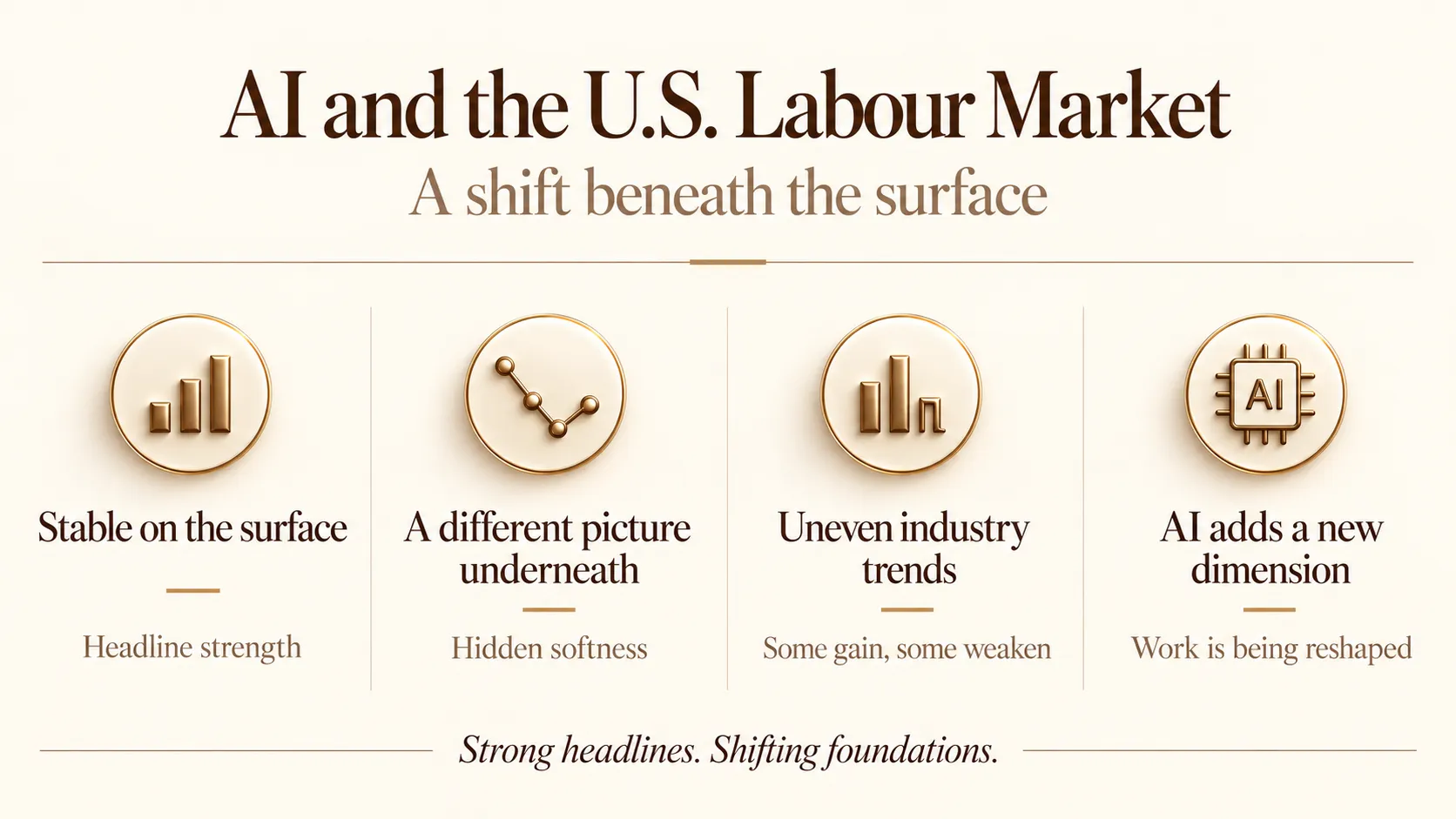
The U.S. labour market has held up relatively well since late 2022. Yet beneath the headline employment numbers, a different picture is emerging. Some industries continue to add jobs, while others are seeing persistent weakness in employment and hiring. The growing adoption of artificial intelligence (AI) adds another dimension to this shift.
November 2022, when ChatGPT was launched publicly, offers a useful starting point to track these changes. While the trends since then do not establish that AI is directly responsible for job losses, they offer clues about where labour demand is weakening, and where it continues to grow.
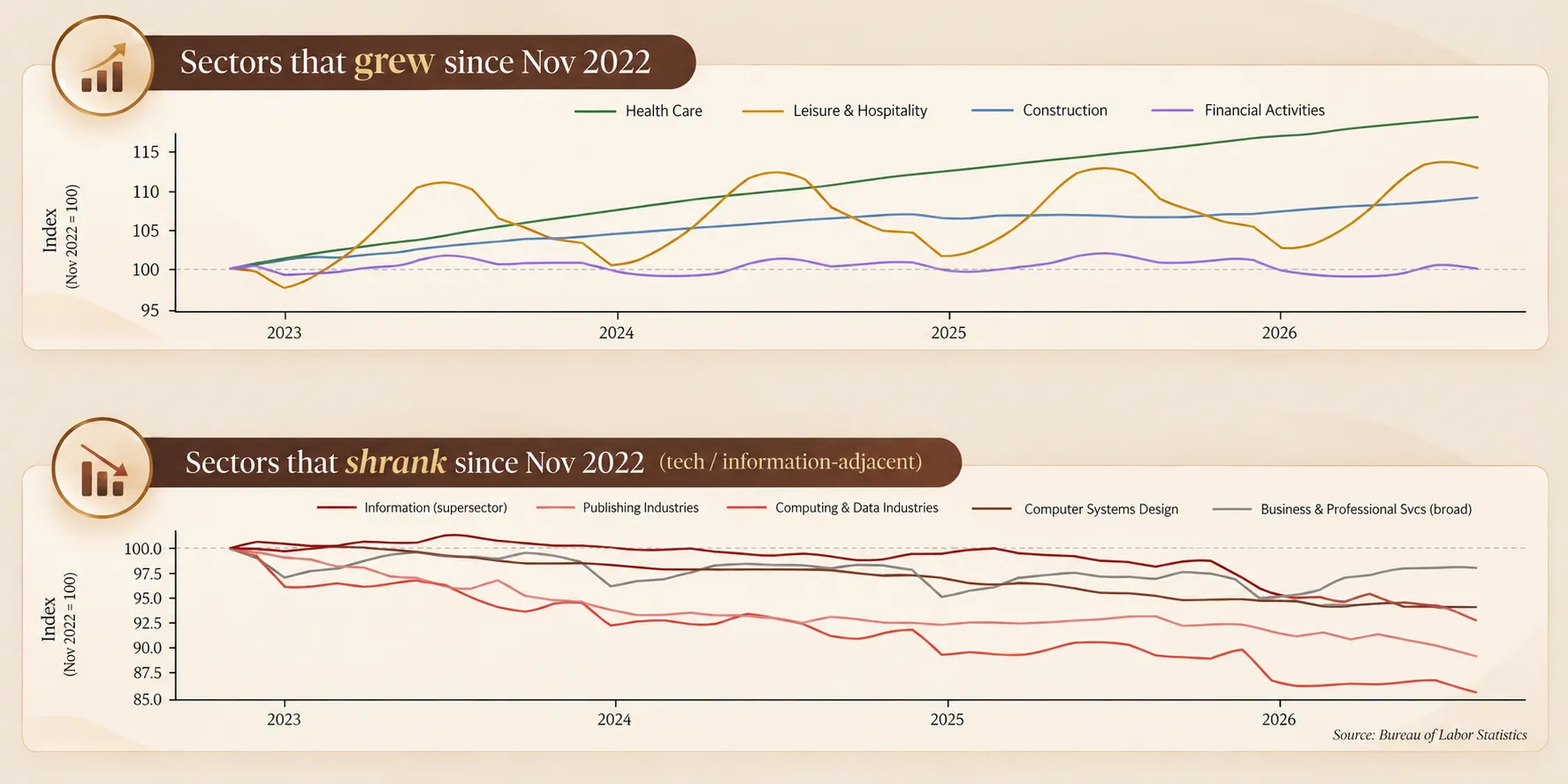
The divide across industries is becoming clearer. Since November 2022, employment in healthcare has grown by 14.3%, while leisure and hospitality have expanded by 10%. Construction has also recorded steady gains. Technology-related segments, however, have faced greater pressure. Employment in computer systems design has declined by 4.8%, computing and data industries by 6.1%, and publishing by 8.6%. The broader Information sector has recorded an even sharper 11.6% decline.
The difference is not limited to employment. Hiring demand in the Information sector weakened sharply at the end of 2022, with the job openings rate falling 59% between November and December. This coincided with a broader correction following the technology-sector hiring boom of 2021–22. More importantly, job openings remained subdued through 2023–26, while healthcare and leisure and hospitality continued to record relatively stronger demand.
Worker mobility has weakened as well. The Information sector's quits rate which is the share of workers voluntarily leaving their jobs declined after 2022, while its hiring rate remained below earlier levels. Together, these trends point to a sector where opportunities to change jobs have become more limited and employers have become less active in recruitment.
Could AI be contributing to this shift? The timing makes it an important factor to watch, particularly in activities involving coding, content generation and data processing. However, the technology-sector correction, changing business priorities and broader economic conditions are also relevant.
There are nevertheless reasons to pay attention. The pace of contraction in Information-sector employment moderated from 4.1% in 2023 to 1.7% in 2025, suggesting some stabilisation. This improvement did not continue into 2026, when employment in the first eight months pointed to an annualised decline of 5.5%. Employer-reported layoff data has also increasingly cited AI as a reason for workforce reductions.
The emerging concern is that AI could be changing how businesses allocate work and approach hiring. As certain tasks become easier to automate, employers may need fewer workers for some activities, even as demand for other skills rises. Whether this develops into a broader employment trend remains to be seen.
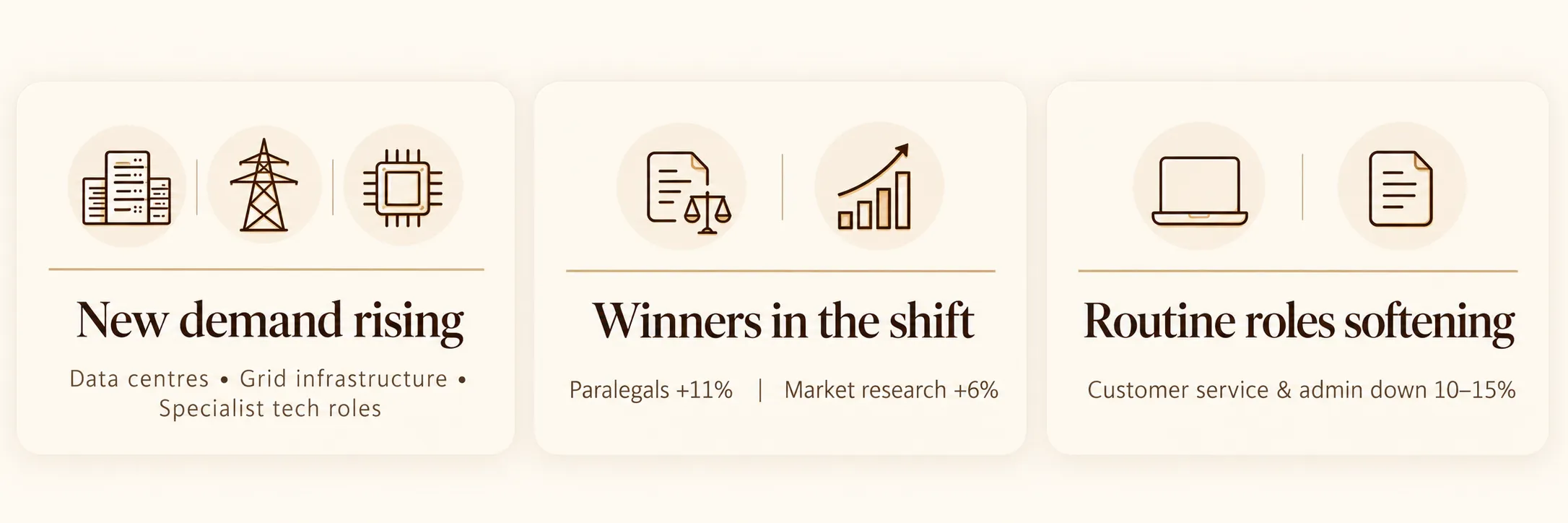
But there is another side to the story. AI is creating demand for data centres, electricity and grid infrastructure, specialised technology roles and supporting professional services. Looking beyond industries to individual occupations makes the picture more nuanced. According to the U.S. Bureau of Labor Statistics’ Occupational Employment and Wage Statistics (OEWS), as cited in The Economist’s recent analysis, employment among paralegals and market research analysts has risen by approximately 11% and 6%, respectively, since 2023. Meanwhile, more routine roles, including customer service and administrative assistants, have recorded declines of around 10–15%.
This distinction matters because exposure to AI does not automatically mean a job will disappear. Technology may automate parts of a role while leaving the wider occupation intact or even increasing demand for workers who can use the tools effectively. The impact depends on the tasks involved and whether AI replaces human effort or complements it.
The broader labour market, therefore, is not showing a uniform employment downturn. Instead, continued job creation in some sectors is occurring alongside persistent weakness in others. Headline payroll growth alone may not capture the structural changes taking place beneath the surface.
For now, the evidence points to an uneven adjustment rather than a broad-based employment downturn that can be attributed to AI. Hiring trends, job mobility and changes in occupational demand may offer more useful signals of how businesses are adapting as the technology becomes more widely adopted.
If you’re a partner, looking to grow your business, click here - Invest with Expert Guidance. Grow with Confidence. | Centricity
If you’re an investor, starting your investment journey, click here- Invest Yourself | Centricity